


Network Monitor
Monitor URLSession requests from your iOS Simulator app without proxy certificates. Inspect headers, bodies, status codes, logs, and cURL commands.
Powered by RocketSim Connect, you can monitor outgoing URLSession requests from your iOS Simulator app without setting up a proxy, installing custom certificates, or switching away from the Simulator.
Open the side window and select the Networking tab with the antenna icon. RocketSim shows the latest requests inline, and you can click Open Network Monitor to inspect the full real-time console.
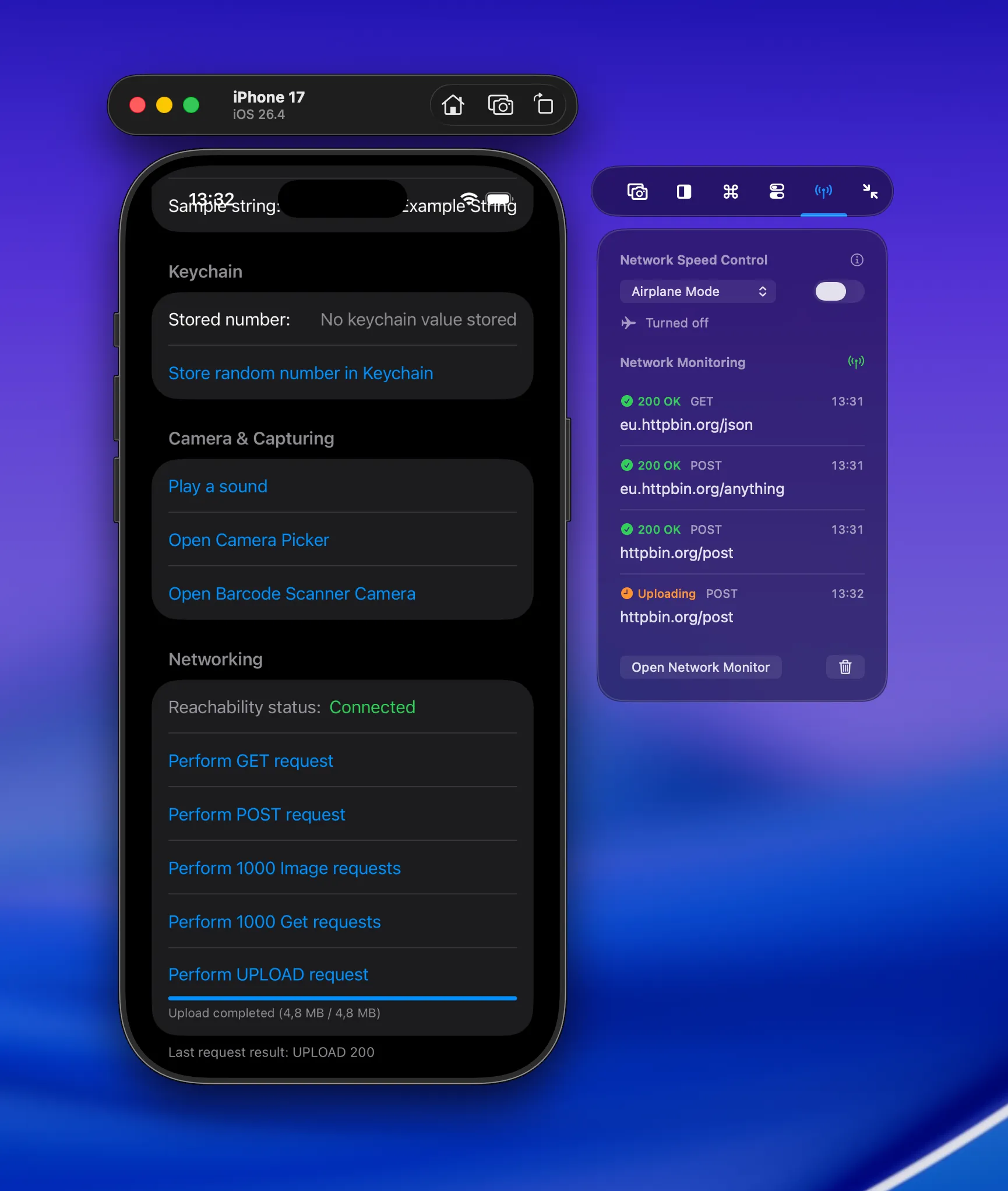
Being able to see which requests are running is essential for a fast development workflow. It helps you catch duplicate calls, failed responses, oversized payloads, and unexpected request order while the app is still running in the Simulator.
RocketSim also shows connected app logs in the Network Monitor, so you can line up request traffic with what your app is printing at the same moment.
Requests and logs together
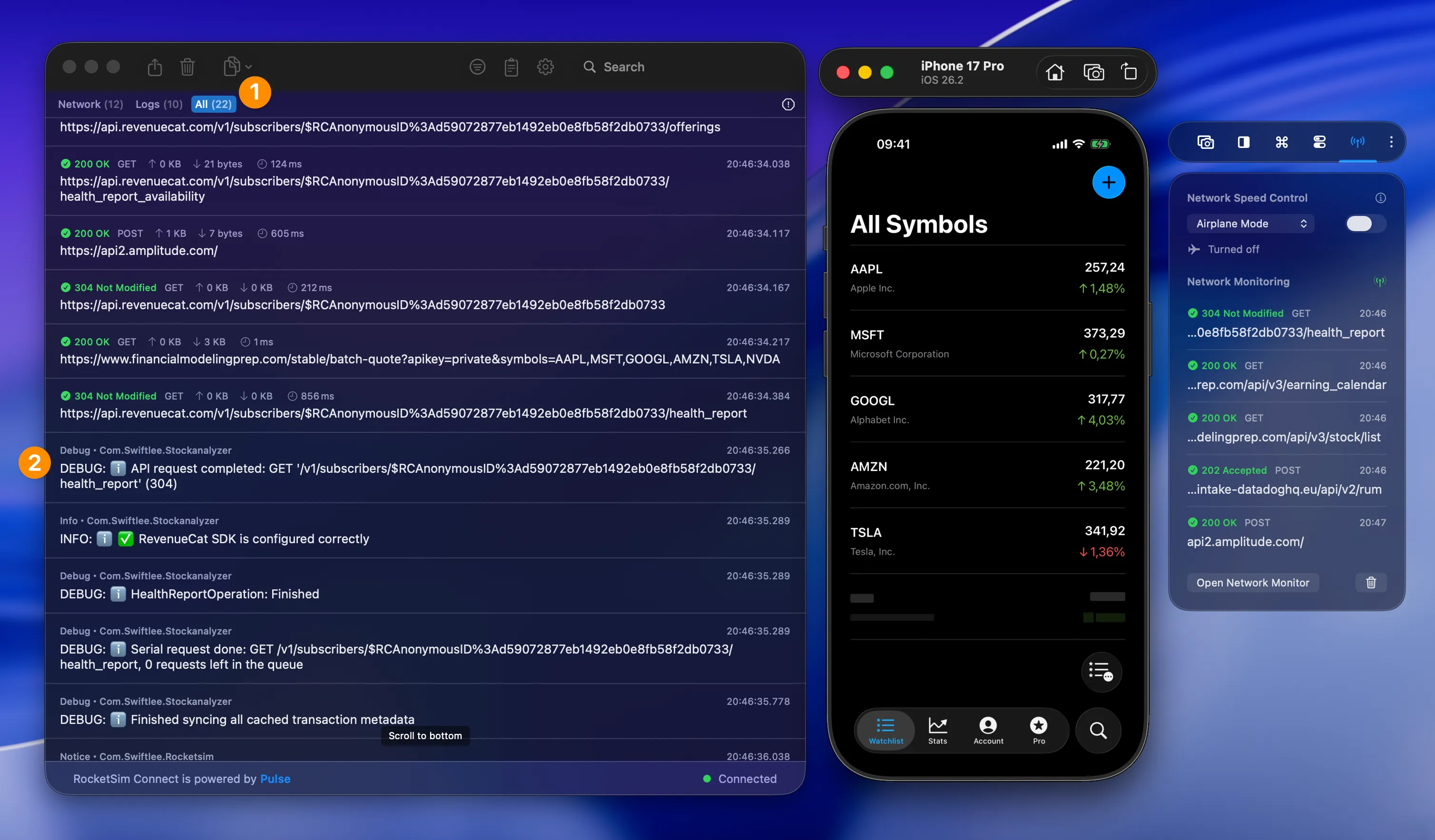
Section titled “Requests and logs together”Use the toolbar tabs to focus on Requests, Logs, or an All view that combines both into a single timeline (1). This makes it much easier to answer questions like “which request fired right before this warning?” without jumping between separate tools. When All is selected, logs appear mixed in with requests so you can better understand when requests fired by looking at the surrounding log output (2).
Insights overview
Section titled “Insights overview”You can see aggregated insights across all your apps for the selected time period: failure spikes, duplicate calls, caching opportunities, slowest endpoints, and most requested URLs. Use the toolbar to switch to a specific application or a different time range.
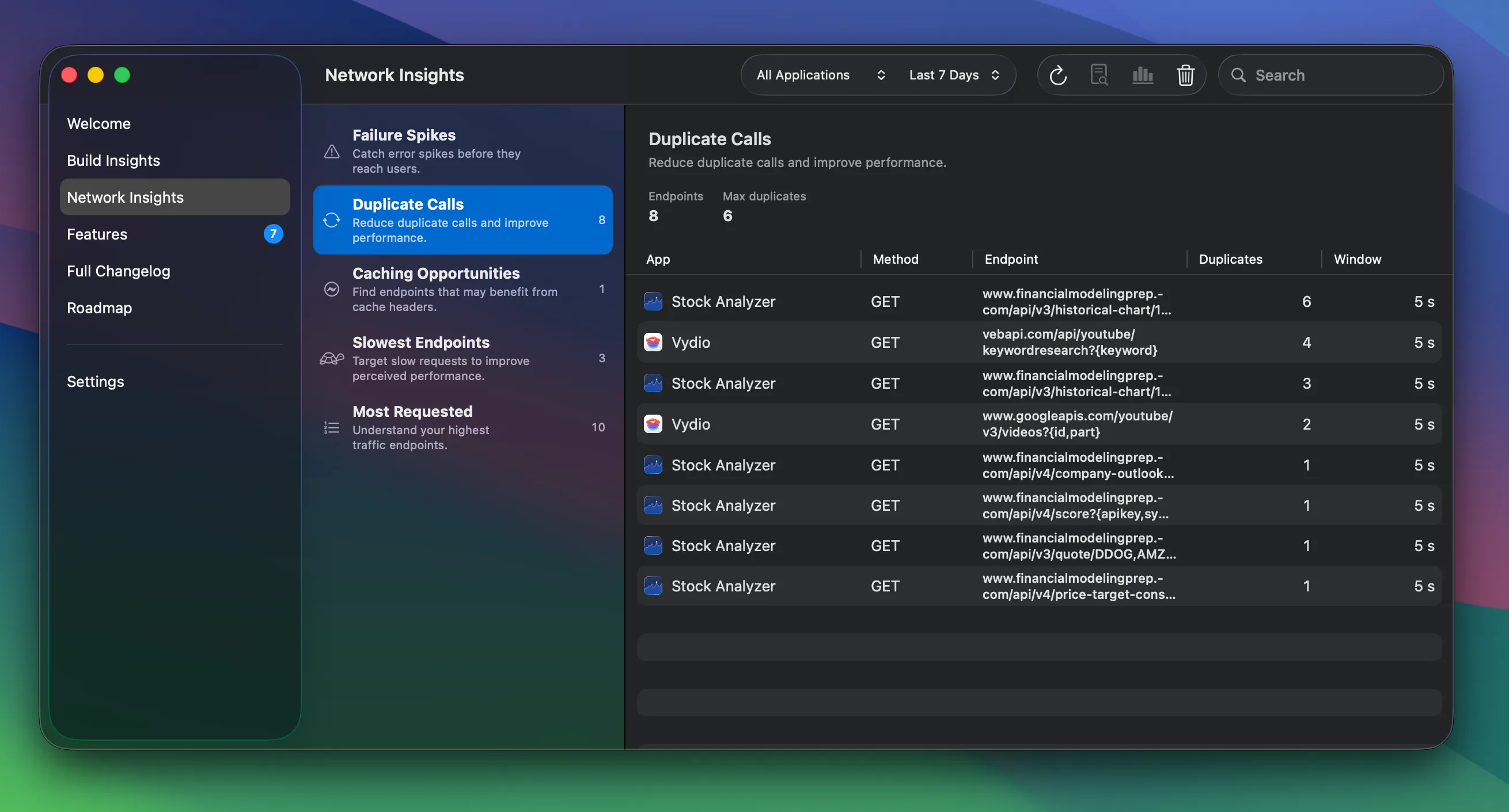
For the historical view and the built-in prompt export workflow for AI-assisted debugging, see Networking Insights and Exporting Network Requests as Prompts.
Inspecting a request
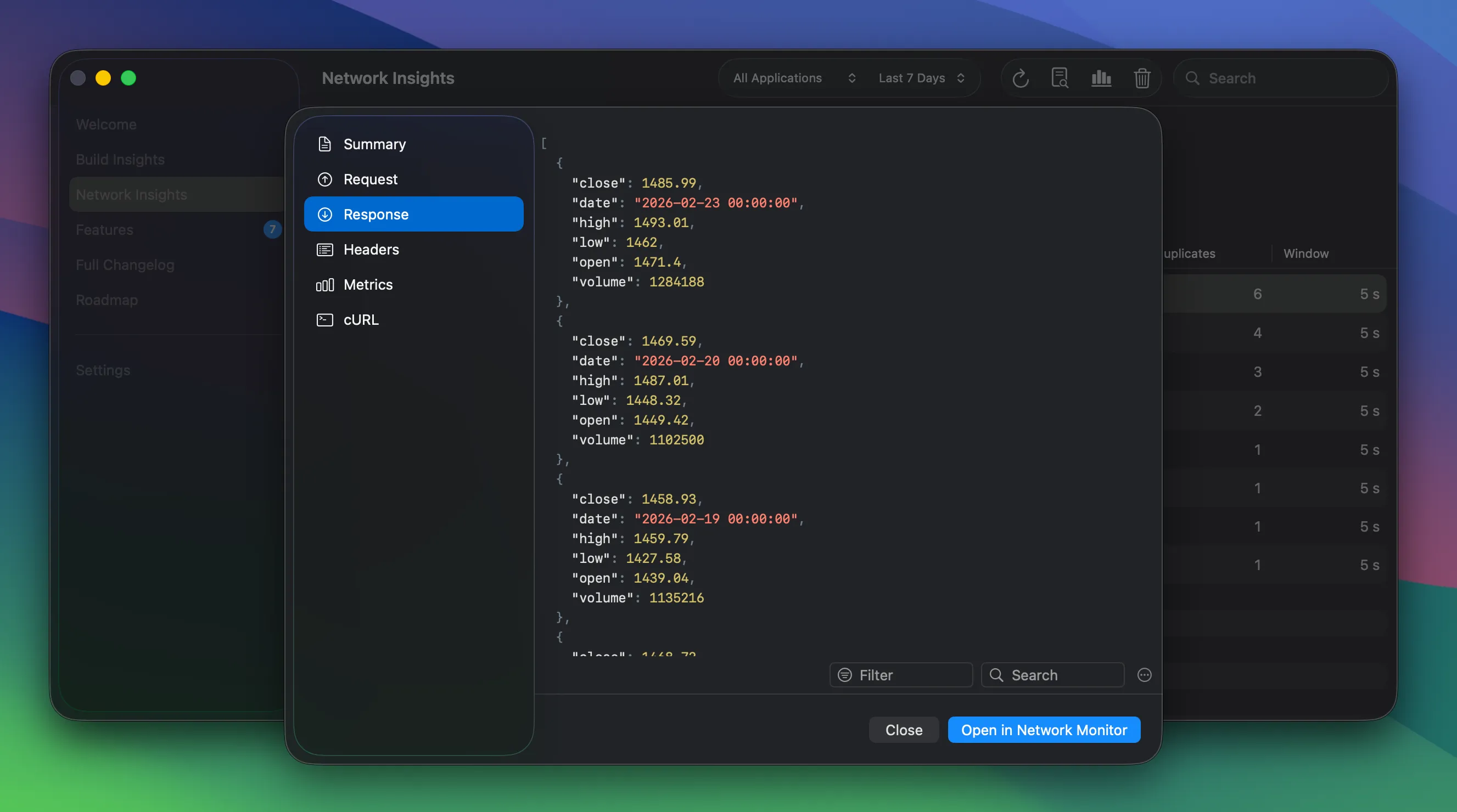
Section titled “Inspecting a request”Open the detail view for any request by double-clicking it in the list or using the toolbar button. From there you can inspect the summary, request and response body, headers, and metrics. You can also copy the request as a cURL command to reproduce the same call from the terminal or share it with your team.
Copying summaries and prompts
Section titled “Copying summaries and prompts”RocketSim includes shareable export options for the current request set:
- Copy export for a compact redacted summary
- Copy prompt for built-in AI prompt templates such as redundant calls, performance, and failures
- Copy Summary on an individual request when you want to share one safe, redacted request summary
See Exporting Network Requests as Prompts for the full workflow.
How does this work?
Section titled “How does this work?”RocketSim Connect’s dynamic library gets loaded at runtime and swizzles URLSession methods to catch networking activity.
How do I get started?
Section titled “How do I get started?”Follow the instructions for RocketSim Connect as described here.
Do I need to set up a proxy or certificates?
Section titled “Do I need to set up a proxy or certificates?”Nope! Integrating RocketSim Connect is all you need.
Are you saying I don’t need Proxyman, Charles Proxy, or any other proxy app anymore?
Section titled “Are you saying I don’t need Proxyman, Charles Proxy, or any other proxy app anymore?”For everyday Simulator debugging, often yes. RocketSim is designed for quickly seeing which URLSession requests go in and out, what responses they return, and why a request failed.
Proxy tools like Proxyman or Charles Proxy are still useful when you need advanced proxy workflows such as rewriting responses, breakpoints, or traffic from apps you cannot instrument. RocketSim focuses on the fast development loop for your own app: no proxy certificates, no system proxy setup, and request details next to your Simulator workflow.
Powered by open-sourced framework Pulse
Section titled “Powered by open-sourced framework Pulse”Network monitoring is made possible by Pulse, an open-sourced library developed by Alex Grebenyuk. For a more advanced Network Logger that includes powerful mocking capabilities, advanced filtering, and more — check out Pulse Pro.